
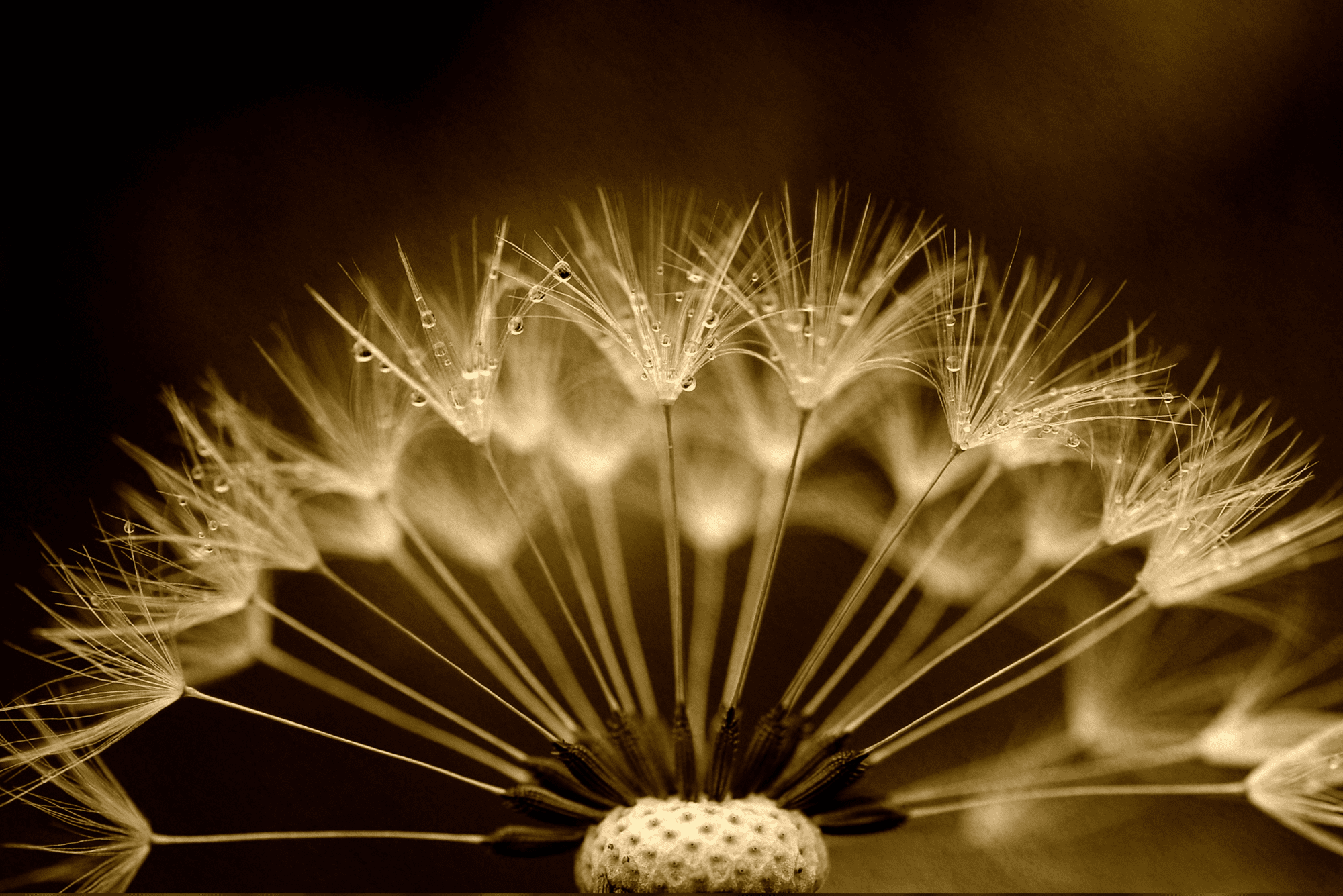
Seeds shape our world. They are the tiny biological powerhouses driving all life on Earth.
Let the words sink in . . .
ALL LIFE ON EARTH.
From seeds grow plants, then flowers, then fruit, then seeds once more. The cycle continues as it has for millennia.
Why should we care? Because we rely on this cycle for the survival of our species.
- Plants are the primary link in our food chain.
- Plants clean and recycle the air we breathe to maintain our atmosphere.
- Plants purify our drinking water while shaping the Earth’s water cycle and micro-climates.
- Plant chemicals provide the building blocks for medications and pharmaceuticals.
- Plants produce the fibers and materials we need to build, write, invent, and create.
So, there you have it. All of humanity’s basic needs—air, food, water, shelter, clothing, medicine—are all provided by plants and seeds. Our very existence depends on them.
In this article, you will learn the importance of seed saving, the history and current issues of seeds, where to purchase heirloom seeds, and types of edible seeds for a healthy diet.

The Importance of Seed Saving
You see the magic of seeds when you walk through your front door, when you open your refrigerator, and when you dig into your dinner plate. From the food you eat to the flowers outside your window, seeds perpetually influence your daily life. However, in today’s modern world of international shipping, grocery stores, and convenience foods, many people are losing touch with exactly where our nutrition comes from.
It is easy to wonder, “What’s the point of saving seeds when you can just purchase them?” Saving seeds and gardening can seem like so much work to add to our already busy lives that most people think, “Why bother?”
We assume that the task of growing food and saving seeds should be left up to professional farmers, large corporations, and governments who know what they’re doing. However, this mindset has allowed the devastating decline in global crop genetic diversity that is now threatening food security across the globe.
When you decide to save seeds, you become a part of something much larger than just your backyard garden. You become part of a global community of seed savers who are preserving and creating beautiful, nutritious plants for generations to come.
How to get started:
Join online seed-saving communities like seedsavers.org to share inventory and preserve this ancient practice.
Learn how to select seed varieties and start seeds indoors so you can grow seed crops.
Learn to grow a sustainable garden with the article The perpetual veggie garden (never buy another transplant or seed packet again!)
Learn to save seeds from fruit, vegetables, herbs, and flowers.
For an in-depth education on the art of seed saving, read THE SEED SAVING BIBLE [10 Books in 1]: The Complete Expert’s Guide To Harvest, Store, Germinate, Keep Your Vegetable And Herb Seeds Fresh For Years & Build Your Seed Bank Like A Pro.
By practicing the art of seed saving we can:
- Ensure Food Security
- Preserve Biodiversity
- Foster Climate Adaptation
- Save Pollinators
- Safeguard Human Rights
- Create Connection
- Uphold Knowledge
- Improve Nutrition
- Encourage Self-reliance
- Save Money
- Develop Superior Seeds

The History of Seeds
For an in-depth look at how humanity’s history intertwines with seeds, check out this book, The Triumph of Seeds: How Grains, Nuts, Kernels, Pulses, and Pips Conquered the Plant Kingdom and Shaped Human History.
Ancient Seeds
Humankind’s relationship with seeds is woven throughout the threads of history. Although, scientific evidence dates the emergence of flowering plants (also known as angiosperms) to over 100 million years before Homo sapiens first appeared on the planet. The oldest known fossil of a flowering plant dates to the Early Cretaceous period around 135 million years ago. For millennia, these adaptable, seed-bearing plants have conquered Earth’s landscape, vastly outnumbering their predecessors—ferns and conifers.
Following the Ice Age, receding glaciers gave way to long dry summers, allowing the growth of annual grasses which reproduced via seeds that would germinate when conditions were favorable. Early humans gathered the seeds of these grasses, also known as wild grains or “cereals”, along with fruit, nuts, and leaves. Societies foraged and hunted their lands, handing down the knowledge of edible plants from generation to generation.
Throughout tens of thousands of years, bioregional plant varieties evolved with characteristics that made them easily identifiable by the people of their habitat. In the Neolithic Revolution, over 10,000 years ago, cultures all around the world began to save and sow seeds from edible and medicinal plants. Scientists believe that this slow birth of agriculture took place over thousands of years across several distinct global regions including the Fertile Crescent of Mesopotamia, the Yangtze and Yellow River basins of China, Central Mexico to Northern South America, the Papua New Guinea Highlands, Eastern North America, and Southern Africa.

The knowledge of collecting and planting seeds ushered in a new age of human evolution as people could now control their food supply and ensure survival for their families. Nomadic lifestyles gave way to stationary farming communities, forever changing the course of human health, politics, and history.
These crops, known today as “ancient grains”, included lentils (Lens culinaris), peas (Pisum sativum), barley (Hordeum vulgare/sativum), flax (Linum usitatissimum), einkorn grain (Triticum monococcum), emmer wheat (Triticum dicoccum), chickpeas (Cicer arietinum) and bitter vetch (Vicia ervilia). All eight of these grains are still grown today and closely resemble their ancient ancestors in both plant characteristics and nutritional value.
Over time, more wild plants (along with livestock animals) were domesticated, as early farmers realized that they could improve their crops by influencing natural selection. Choosing the most robust and flavorful plants to save seeds from, resulted in the emergence of cultivated quinoa, amaranth, rice, millet, rye, wheat, squash, peanuts, yuca, beans, sugarcane, dates, and other fruits. As more genetic mutations took place and thousands of years passed, crops such as corn, potatoes, peppers, tomatoes, olives, cocoa, tobacco, pineapple, and sunflowers, amongst others, began to be cultivated by indigenous peoples.
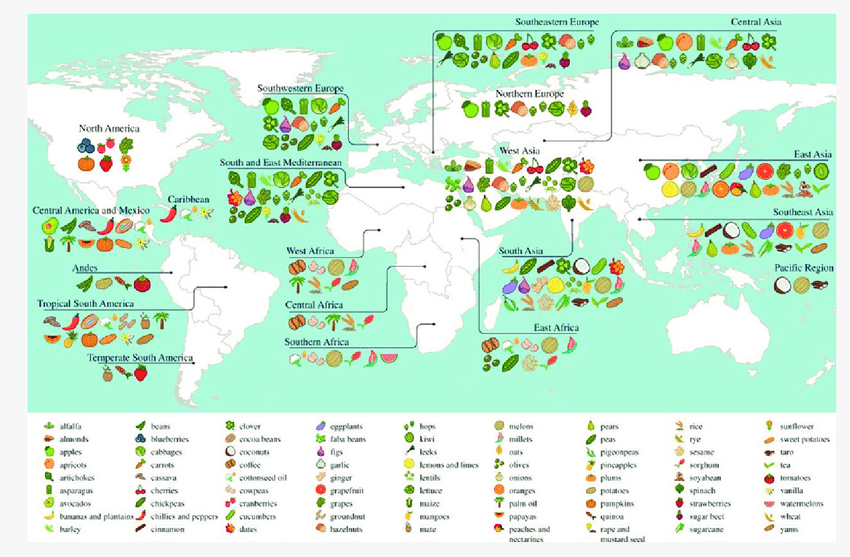
(Map of the world with origins of staple crop species)
In 1492, when Columbus sailed the ocean blue, seeds began their journey across the Atlantic. This voyage became known as the Columbian Exchange. Once unknown foods soon became dietary staples in places where they had never grown before. Italians had never seen tomatoes and the Irish had never tasted potatoes until these seeds arrived in ships from “the New World”. Botanists began to understand how to use selective breeding to birth new cultivars of edible plants including vegetables, grains, and fruits.
Agriculture expanded with the rise of the Industrial Revolution in the late 1700s, resulting in a huge global population explosion. This created a never-ending race between population growth and agricultural output. Technology and mechanical equipment revolutionized farming, allowing for faster harvesting, more efficient and accurate seeding, and less labor-intensive field preparation.
The mechanization of farming made it more efficient for farmers to plant one type of crop in large groups, known as mono-cropping. This practice has been implemented on a wide scale in cultures across the globe, eliminating crop diversity as well as local plant species and animal habitats. This farming method has traditionally relied heavily on fertilizers and pesticides to overcome soil and pest issues.
At the turn of the 20th century, seed companies began to offer hybrid (cross-bred) crop varieties as superior alternatives to heirloom (pure-bred) crops. (Learn more about seed varieties here.) This meant that farmers could no longer save seeds from their land, leaving them dependent upon the stock of seed companies each growing season. Governments also began to offer subsidies (paid incentives) for farmers to grow specific types of crops such as corn, wheat, and soybeans to reduce reliance on expensive imports. As a result, seed diversity decreased, and thousands of varieties of edible plants were lost to history.

The Dust Bowl of the 1930s was one of the first major events that demonstrated how human activity could affect climate change. As a result of tilling, bare soil on fields, and other unsustainable farming practices, the southern plains of the United States experienced a decade of drought and dust storms. Millions of tons of topsoil were eroded, causing severe long-term ecological degradation. While conservation measures were taken to correct this agricultural disaster, nearly 100 years later, most farmers still employ these same damaging agricultural methods that destroy topsoil.
In the past century, seed diversity has dropped by over 94%
Seeds Today
I highly recommend the documentary film, SEED: The Untold Story for an eye-opening account of our global seed crisis and the movement to recover our planet’s seed diversity. SEED features Vandana Shiva, Dr. Jane Goodall, Andrew Kimbrell, Winona Laduke, and Raj Patel.
A hundred years ago, seed houses offered thousands of varieties of crops, today, however, seed diversity has dropped by over 94%.
Science continues to unlock new doors to modify plants vulnerable to diseases and pests, however drawbacks weigh down the benefits. Seed patents and monopolies deprive farmers of access and reduce the diversity of seeds available in the marketplace. Genetically engineered crops, especially those that rely on wind pollination, can cross-breed with neighboring farmer’s non-GMO crops. Not only can this alter intended outcomes for the farmer’s business, but it can also leave them in violation of the patent on the offending pollinator species.
Food security is now a global concern as famines, droughts, wildfires, and other natural disasters wreak havoc on supply chains. But there is hope as governments worldwide come together to combat the growing threat of climate change and desertification.
Seed banks around the globe strive to preserve genetic diversity for future generations and protect the heritage of different seed species. Changes in agricultural practices have been slow, but with campaigns such as the green revolution and the seed movement, positive momentum continues to build. Permaculture practices and food forests, along with many other sustainable farming practices, are growing in popularity as business owners see the benefit of crop diversification.
Where to Purchase Seeds
Seed companies and communities of seed savers are amazing resources to begin your seed-saving journey. Purchase seeds once and preserve your seed crop for generations. These are some of my favorite places to find unique heirloom seeds:
Seeds Now
True Leaf Market
Pleasant Hill Grain
Eden Brothers Seed Company
Seed Savers Exchange
Amazon
When shopping for seeds that will produce true-to-type offspring and be viable for saving, seek varieties labeled as:
- Heirloom
- Open-pollinated
- Self-pollinated
- Non-GMO
- Organic
Labels to avoid when seed saving:
- Hybrid
- Seedless
- Cross-pollinated
- Genetically Modified (GMO)
- Grafted

Edible Seeds
The importance of seeds extends beyond just their ability to reproduce. Seeds are also a significant source of nutrition and are the basis for many dietary staples.
Have you ever eaten rice, oatmeal, tortillas, or bread? Then you have eaten seeds. How about quinoa, chia, or sesame? Seeds again. Ever tried beans, peas, lentils, or nuts? That’s right, these are all seeds.
Seeds go by many names, but they all have one thing in common – the ability to grow into a plant. You may hear seeds referred to as berries, grains, kernels, nuts, beans, pulses, pits, cones, oats, or groats, but on the inside, all of these are simply plant embryos.
Cereals
Cereal grains are members of the grass family (Gramineae) and are all wind-pollinated. These crops are prized for their starchy, edible seeds.
Barley, Corn (maize), Einkorn, Emmer, Fonio (black, white), Kamut, Kernza, Millet (barnyard, finger, foxtail, little, pearl, proso), Oat, Rice (Asian, African), Rye, Sorghum (sweet, grain, broomcorn, forage), Teff (white, brown, mixed), Wheat, Wild Rice (Manoomin, Northern, Texas), Triticale.
Pseudo-cereals
The true cereals belong to the grass family, but pseudocereals are grains from other plant families. These grains contain less starch with more proteins and lipids.
Acorn, Amaranth (love-lies-bleeding, red amaranth, prince-of-wales-feather, grain, leaf, red garnet, Joseph’s coat), Breadnut, Buckwheat, Cañahua, Chia (white, black, brown), Cockscomb (also called quail grass or soko), Fat hen, Flax, Hanza, Kaniwa (red, black), Pitseed goosefoot, Quinoa (white, red, black, rainbow, tri-color), Sesame, Wattleseed (also called acacia seed).
Legumes
Legumes are members of the pea family (Fabaceae) and are characterized by their pods which split open to release seeds. Most legumes fix nitrogen in soil and are prized as companion plants or cover crops.
Aburaage (soybean product), Adzuki beans (Azuki, Red mung bean), Alfalfa, Anasazi beans, Appaloosa beans, Asparagus beans (Yardlong bean), Atsuage (soybean product), Awase Miso (red and white miso), Azufrado beans, Barley Miso (Mugi miso), Bayo beans, Bean curd skin (Yaba), Black Adzuki beans, Black beans, Black chickpeas, Black-eyed peas (cowpea), Black kidney beans, Black nightfall beans, Black valentines, beans, Black lentils, Black soybeans, Black turtle beans, Bolita beans, Bonavist beans, Borlotti beans (cranberry beans, Roman beans), Bountiful beans, brown lentils, Brown speckled cow beans, Broad beans, Butter beans, Calypso beans, Canary beans, Cannellini beans (White kidney beans), Chickpeas, Christmas Lima beans (chestnut lima beans), Climbing French beans, Cowpeas, Crab eye beans (note crab eye seeds are different and are poisonous), Dark red kidney beans, Dwarf peas, English peas, European Soldier beans (Navy beans), Eye of Goat beans, Fava beans (Broad beans), Flageolet beans, Garden peas (English peas), Great Northern bean (related to the Navy bean), Hyacinth bean (Lablab), Inariage (fermented soybeans), Jackson Wonder Lima bean, Kidney beans, Kinugoshi (Kinu-dofu, silken tofu), Koya-dofu (freeze-dried tofu), Lablab, Lentils, Licorice, Lima beans, Lingot beans (white kidney beans), Lupin seeds, Maine yellow-eye beans, Mayocoba beans, Molasses Face beans, Mortage lifter beans, Mung beans, Natto (fermented soy beans), Navy beans, Okara, Ocra beans, Otebo beans, Peanuts, Peas, Pigeon peas (Anhar, Toor), Pink beans, Pink lentils, Pinto beans, Potato beans, Puy lentils, Rattlesnake beans, Red beans (Adzuki beans), Red Eye beans, Red lentils, Red Miso, Roman beans (Cranberry beans), Salugia beans, Scarlet runner beans, Shelling peas, Small red beans, Small white beans, Snow peas, Southern peas (Cow peas, Black Eyed peas), Soybeans, Steuben yellow beans, Sugar snap peas, Tempeh, Tongue of Fire beans, Trout beans, Turtle beans, Usuage, Vallarta beans, Vaquero beans (Orca beans), Winged beans, Yellow Lentils, Yellow Miso, Yin Yang beans, Yuba (fermented soybeans), Yellow Indian Women beans.
Nuts
Nuts are dry single-seeded fruits with oily flesh surrounded by a hard shell and belong to the walnut family (Juglandaceae). These nutritional powerhouses are full of antioxidants, protein, fiber, healthy fat, vitamins, and minerals but can sometimes cause health issues for allergy sufferers.
Acorns, Almonds, Andean Walnuts, Argan Nuts, Baru Nuts, Beech Nuts, Betel Nuts, Bitter Almond, Black Walnuts, Blanco Almond, Brazil Nuts, Breadnut, Bunya Nut, Butternuts, Canarium Nuts, Candle Nuts, Caramel Almond, Cashews, Chestnuts, Chilean Hazelnut, Chinese Chestnut, Dika Nuts, English Walnut, Filberts (Hazelnuts), Fritz Almonds, Gabon Nuts, Ginkgo Nuts, Green Almonds, Hickory Nuts, Jack Nuts, Kola Nuts, Kurrajong Nuts, Lotus Nuts, Macadamia Nuts, Malabar Chestnut, Marcona Almond, Mission Almond, Mongongo Nuts, Monkey Puzzle Nut, Oysternut, Padre Almond, Palm Nuts, Paradise Nut, Peanuts, Pecans, Peerless, Almond, Pignoli Nuts, Pili Nut, Pine Nuts, Pistachios, Red Bopple Nut, Runner Peanut, Saba Nuts, Spanish Peanut, Tiger Nuts, Valencia Peanut, Virginia Peanut, Water Caltrop.
Other Edible Seeds
There are so many types of edible seeds, it’s difficult to place them all into neat categories. The following are a few types of edible seeds that don’t fit in with the above groups.
Basil, Borage, Cempedak, Cocoa bean, Coconut, Coffee bean, Cumin, Durian, Hemp, Jackfruit, Lotus seed, Nigella, Mustard seed, Osage orange seed, Papaya seed, Passion Fruit seed, Poppy seed, Pomegranate, Psyllium, Pumpkin, Sunflower, Watermelon seed.

Learn to Save Seeds
Are you interested in learning more about the ancient art of seed saving? Download my E-Book, Saving Vegetable Seeds: A Quick Start Guide for detailed instructions on the seed-saving process with specific techniques for 20 different fruit and vegetable species.
Grow your own seed stash and find gardening inspiration with these other helpful posts:
How to Start Seeds Indoors and Keep Them Alive!
Unlock the Secrets to a Perfect Garden Layout! (A Reference Tool for Gardeners)

3 thoughts on “The Secret World of Seeds: Ancient Knowledge”