What would you do with $100,000 if it landed in your lap tomorrow? Would you take off on a world tour, buy a luxury car, or finally build that dream homestead you’ve been longing for? While those ideas are tempting, there’s a smarter way to think about it: $100,000 isn’t just money—it’s a springboard to financial freedom if you use it right. Here’s how to make that money multiply with tips from a pro investor—drawn from my real-world experience building wealth through real estate, business, and smart financial strategy.
The truth is, how you invest $100,000 could completely change your life. With the right plan, it could generate consistent monthly income, double (or triple) in value, and even buy you back your time. The key is to stop thinking like a spender and start thinking like an investor. As a real estate investor and wealth-builder, I’ve learned that money is a tool—and the way you use it matters more than how much you have.
Let’s explore the smartest ways to invest $100,000, with real numbers, comparisons, and creative strategies. By the end, you’ll not only know how to grow $100,000 into something much bigger—you’ll see how to make it work for you long after it’s spent.

What Would You Do With $100,000? Let’s Explore the Smartest Strategies
Before you put that $100,000 anywhere, it’s important to get clear on your goals. Do you want steady cash flow now or explosive growth later? Are you more focused on building long-term wealth or generating passive income you can live on today? Your priorities shape how you should invest.
Here are the top tips from a pro investor for putting $100,000 to work—each with its own personality, potential, and payoff.
Disclaimer: This article is for educational and informational purposes only and does not constitute financial, legal, or investment advice. All investment strategies and examples discussed are illustrative and based on historical averages, estimates, or personal experience. Actual results will vary based on individual circumstances, market conditions, and other factors. Before making any investment decisions, consult with a qualified financial advisor, tax professional, or attorney to determine what strategies are appropriate for your specific situation.
Long-Term Real Estate Rentals: Tangible Wealth That Pays You Monthly
If you want an investment that builds equity, grows in value, pays you steady income every month, and gives you control over your financial future, long-term rental properties are one of the most proven real estate wealth-building strategies. And it’s not just for the ultra-rich—$100,000 is enough to launch a strong, cash-flowing portfolio.
How It Works
Let’s say you invest $100,000 as a 20% down payment on a $500,000 rental property. That means you’re financing the remaining $400,000 with a 30-year fixed mortgage at about 6.5% interest.
Here’s how the numbers break down:
- Loan amount: $400,000
- Interest rate: ~6.5% (30-year fixed)
- Monthly principal & interest: ? $2,528
- Taxes & insurance: ? $400/month
- Maintenance & reserves: ? $150/month
Total monthly expenses: ? $3,178
Multifamily properties can typically yield landlords a higher return than single-family. To achieve a $1,500/month net cash flow, the property needs to rent for about $4,700/month:
- Rental income: ? $4,700/month
- Total expenses: ? $3,178/month
- Net cash flow: ? $1,522/month ($18,264/year)
That’s an 18% cash-on-cash return—meaning your $100,000 investment earns you about $18,000/year in passive income before appreciation and tax benefits.

The Long-Term Wealth Multiplier
Monthly cash flow is just one part of the wealth-building equation. As your tenants pay down the mortgage, you’re also building $5,000–$7,000 per year in equity. And if the property appreciates at a modest 4% annually, it could be worth about $740,000 in 10 years—adding roughly $240,000 in appreciation alone.
Over a decade, here’s what your investment could produce:
- Cash flow: ~$180,000
- Property appreciation: ~$240,000
- Loan paydown equity: ~$60,000+
Add it all up, and your original $100,000 could grow into $500,000+ in total wealth over 10 years—all from one rental property.
Tax Benefits That Supercharge Your Returns
Real estate also comes with major tax advantages that boost your bottom line. You can deduct expenses like property taxes, mortgage interest, insurance, maintenance, property management, and even travel costs related to managing the property.
Perhaps the most powerful tool is depreciation—a paper deduction that lets you write off the cost of the property’s structure over 27.5 years. On a $500,000 property, that’s roughly $18,000 in non-cash deductions per year, which can offset most or even all of your rental income. In many cases, that means you keep more of your cash flow tax-free.
If you sell and reinvest through a 1031 exchange, you can even defer capital gains taxes and keep compounding your wealth tax-deferred.
Why It’s Powerful: Real estate leverages your money—your $100,000 controls a $500,000 asset. You’re earning in three ways at once:
- Consistent monthly cash flow
- Equity growth from mortgage paydown
- Appreciation over time
And thanks to tax deductions, depreciation, and strategies like the 1031 exchange, more of that money stays in your pocket—accelerating your wealth even faster.

Run Projections with These Tips From a Pro Investor
One of the smartest moves you can make when deciding what to do with $100,000 is to analyze your numbers before you buy—and tools like DealCheck make that easier than ever. With DealCheck, you can plug in the property price, down payment, loan terms, rent, and expenses to instantly see key metrics like cash-on-cash return, cap rate, annual cash flow, and 5–30 year projections.
It also shows how appreciation, loan paydown, and rent increases will grow your equity over time—so you can compare multiple deals side-by-side and spot the strongest performers. Instead of guessing what your $100,000 investment might do, DealCheck lets you make confident decisions backed by data and clear financial forecasts.
Long-Term Rentals: Landlord Realities to Be Aware Of
While long-term rentals are often considered the “set it and forget it” side of real estate, they’re not entirely without challenges. The biggest risk is non-paying tenants, which can disrupt your cash flow and lead to lengthy eviction processes depending on your state’s laws. You might also encounter property damage, lease violations, or the need for costly repairs and turnover expenses between tenants.
Thorough tenant screening, including background checks, income verification, and landlord references, is your best defense. Many investors also set aside one month of rent per year in a maintenance and vacancy reserve to cushion against surprises. Hiring a reputable property management company (typically 8–12% of monthly rent) can also take the day-to-day stress off your plate—handling rent collection, maintenance calls, and legal compliance—while still letting you enjoy steady, mostly passive income.

Short-Term Rentals: The Cash Flow Powerhouse
If you want higher returns and are willing to be a bit more hands-on, investing in short-term rentals (STRs) like Airbnb and VRBO can turn that $100,000 into a high-performing income machine.
How It Works
Let’s say you invest $100,000 as a 20% down payment and use part of that capital for furnishings and setup on a $500,000 vacation rental property. You’re financing about $400,000 with a 30-year fixed mortgage at around 6.5% interest.
Here’s what the monthly numbers look like:
- Loan amount: $400,000
- Interest rate: ~6.5% (30-year fixed)
- Monthly principal & interest: ? $2,528
- Taxes, insurance, utilities, and maintenance: ? $800/month
- Cleaning, supplies, and management: ? $300/month
Total monthly expenses: ? $3,628
A well-run STR in a desirable market can gross $5,800–$6,500/month ($70,000–$78,000/year or more). After expenses, that leaves roughly:
- Rental income: ? $6,100/month
- Total expenses: ? $3,628/month
- Net cash flow: ? $2,472/month—about $29,664/year
That’s close to a 30% cash-on-cash return—significantly higher than a traditional rental.
The Long-Term Impact
Over 10 years, that’s nearly $300,000 in cash flow. If the property appreciates at a modest 4% annually, it could grow from $500,000 to about $740,000—adding $240,000 in appreciation. The appreciation could be even higher in elite markets for properties with views or waterfrontage. Combine that with loan paydown and tax advantages, and your total wealth could exceed $600,000–$650,000 from this single investment.

Tax Advantages
Short-term rentals also come with powerful tax benefits. You can deduct expenses like mortgage interest, property taxes, cleaning, supplies, furnishings, and even travel to and from the property. Plus, bonus depreciation (often available for STRs if they meet “active participation” standards) can allow you to write off a significant portion of the property’s value in the first year—potentially offsetting most or all of your rental income.
If you decide to sell and reinvest, a 1031 exchange can help you defer capital gains taxes, keeping your money compounding tax-deferred.
Why It’s Powerful: Short-term rentals can deliver 2–3× more monthly cash flow than traditional rentals while giving you flexibility and control. You can adjust pricing dynamically, use the property personally, and scale into a portfolio that generates serious income. Combined with appreciation, loan paydown, and tax benefits, STRs are one of the most powerful wealth-building tools in real estate today.

A Word of Caution: Seasonality and Booking Fluctuations
While short-term rentals can deliver impressive cash flow, it’s important to plan for the natural ups and downs of the market. Most vacation rentals experience seasonality, with peak months generating significantly higher revenue and off-season periods bringing slower bookings—sometimes cutting income by 30–50%.
Weather, school schedules, and local events can all impact demand, and these patterns can shift from year to year. Building a reserve fund to cover slower months, diversifying your marketing across multiple booking platforms, and adjusting your nightly rates with dynamic pricing tools can help smooth out the highs and lows. By planning for seasonal swings, you’ll set more realistic expectations and keep your property profitable year-round.
Property Management: Hands-Off Hosting Made Easy
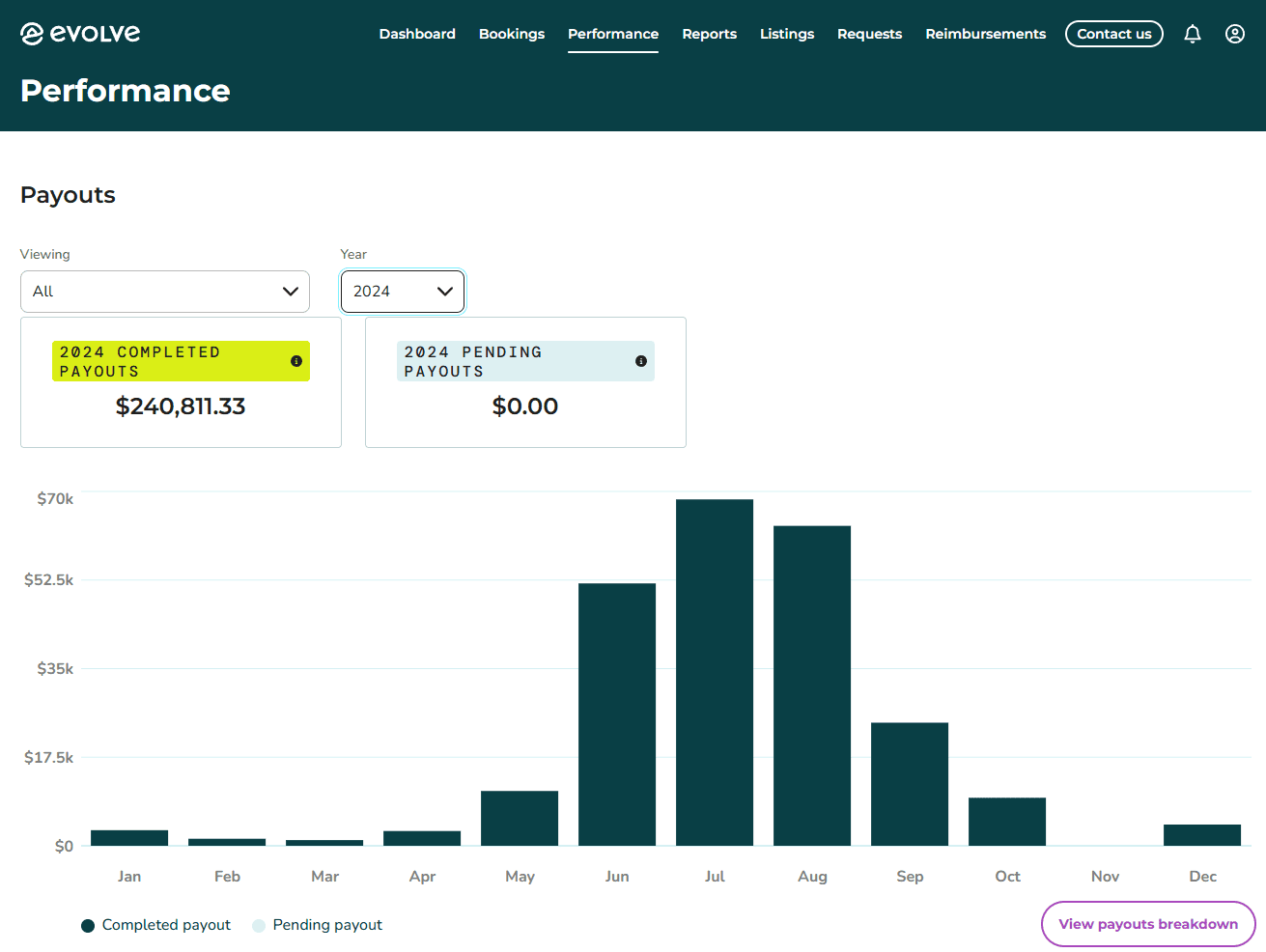
Running a short-term rental can be rewarding, but it’s also time-intensive—guest experience drives reviews and repeat bookings. Guest communication, cleanings, marketing, and maintenance can quickly turn into a second job. That’s where professional property management comes in. Companies like Evolve Vacations handle the heavy lifting for you—from listing optimization and dynamic pricing to guest messaging and cleaning coordination—for about 10% of your rental income, far less than the 20–30% many local managers charge.
Outsourcing management lets you treat your property like a true passive income stream while still earning strong returns. Even if you plan to self-manage at first, partnering with a company like Evolve as you scale can free up your time, reduce stress, and help maximize your profits with professional systems and marketing reach.

S&P 500 Index Funds & Mutual Funds: The “Set It and Forget It” Strategy
If managing tenants, bookings, or property repairs isn’t your style, mutual funds—like S&P 500 index funds—are one of the simplest and most powerful ways to grow wealth. They’re hands-off, low-cost, diversified, and backed by decades of proven performance.
How It Works
A mutual fund is a professionally managed investment that pools money from many investors to buy a diversified basket of stocks, bonds, or other securities. An S&P 500 index fund, for example, automatically invests in 500 of the largest publicly traded U.S. companies—giving you instant exposure to companies like Apple, Microsoft, and Johnson & Johnson without picking individual stocks.
Historically, the S&P 500 has returned about 7%–10% annually (we’ll use 8% here for a conservative projection). If you invest $100,000 and simply leave it alone to compound, here’s what happens:
- 10 years: ~$215,892
- 20 years: ~$466,095
- 30 years: ~$1,000,000+
This growth happens thanks to compound interest—you earn returns on your original investment and on the returns themselves year after year. If you add to your investment regularly, the numbers grow even faster.
For example, if you invest $100,000 upfront and add $500/month for 30 years at 8% annual growth:
- Your total contributions: ~$280,000
- Portfolio value after 30 years: ~$1.37 million
Tax Advantages & Flexibility
Mutual funds held in tax-advantaged accounts like a Roth IRA or 401(k) can grow tax-free or tax-deferred, dramatically boosting your long-term returns. Even in a regular brokerage account, most S&P 500 index funds are tax-efficient because they have low turnover, generating fewer taxable events.
You can sell your shares quickly and easily if you need cash—a level of liquidity that real estate can’t offer. And because you’re diversified across hundreds of companies, your risk is spread out, reducing the impact of any single company’s poor performance.
Why It’s Powerful: Mutual funds, like S&P 500 index funds, are the ultimate “set it and forget it” wealth-building tool. They offer diversification, liquidity, strong historical returns, tax advantages, and zero management headaches—making them ideal for retirement accounts or anyone who wants their money to grow steadily without the hands-on work of real estate.

Dividend Stocks: Passive Income That Grows While You Sleep
Dividend-paying stocks are one of the most reliable ways to turn $100,000 into a steady income stream that grows every year—and you don’t need to sell shares to get paid. These investments reward shareholders with regular cash payments (dividends), typically every quarter, just for owning them. Many of the world’s most stable companies—like Johnson & Johnson, Procter & Gamble, and Coca-Cola—have raised their dividends every year for decades, even during recessions.
How It Works
Let’s say you invest $100,000 into a portfolio of high-quality dividend stocks with an average 4% dividend yield. That means:
- Annual dividend income: $4,000
- Monthly income: ? $333
If you reinvest those dividends, the compounding accelerates. Assuming an average total return of 8% per year (4% dividends + 4% growth), your portfolio could grow like this:
- 10 years: ? $215,892—now paying about $8,635/year in dividends
- 20 years: ? $466,095—now paying about $18,644/year
- 30 years: ? $1,000,000+—now paying over $40,000/year
That’s income that grows automatically over time—even if you never invest another dollar. Many investors eventually live off their dividends entirely, treating them as a form of “retirement paycheck.”

Borrowing Against Your Portfolio: A Hidden Wealth-Building Tool
One of the most powerful (and often overlooked) advantages of owning dividend stocks or mutual funds is that you can borrow against them instead of selling. Brokerages like Morgan Stanley, Fidelity, and E*TRADE offer portfolio lines of credit (PLOCs) or securities-backed loans, typically lending 50%–70% of your account value at interest rates much lower than traditional loans.
For example, if your portfolio grows to $500,000, you could borrow around $250,000–$350,000—often at 5%–7% interest—without triggering capital gains taxes, since you’re not selling the investment.
Benefits:
- No credit check or income verification—your portfolio is the collateral.
- No capital gains tax from selling shares.
- Funds can be used for real estate investments, business opportunities, or emergencies.
Drawbacks & Risks:
- If the market drops significantly, you could face a margin call, requiring you to repay part of the loan or sell shares.
- Interest costs eat into your returns if you’re not careful.
- Overborrowing can over-leverage your portfolio and add risk during market downturns.
When used strategically, borrowing against your investments lets you tap into liquidity without losing ownership—a powerful wealth-building tool used by many seasoned investors.
Why It’s Powerful: Dividend stocks blend cash flow and long-term growth like few other investments can. They provide income without needing to sell shares, offer compounding returns if reinvested, and give you the option to leverage your portfolio for bigger opportunities—all while remaining one of the most passive ways to build wealth.

Private Lending: Be the Bank and Earn Like One
What if you could invest in real estate without owning property, dealing with tenants, or handling repairs—and still collect steady monthly income? That’s exactly what private lending allows you to do. Instead of buying real estate yourself, you lend money to investors, house flippers, or developers, and they pay you interest just like they would a bank. It’s one of the most passive ways to earn income backed by real estate.
How It Works
Let’s say you lend $100,000 to a real estate investor at 10% annual interest on a 12-month note secured by the property they’re purchasing or renovating. Your terms might look like this:
- Loan amount: $100,000
- Term: 12 months
- Interest rate: 10%
- Annual income: $10,000
At the end of the loan, you get your $100,000 principal back, and you’ve earned $10,000 in interest. Repeat that every year, and over 10 years you could earn $100,000 in cash flow—effectively doubling your money without ever buying property yourself.
Some private lenders structure their loans with monthly interest payments (about $833/month in this example), while others receive a lump sum of interest at the end of the term. Either way, the income is typically secured by a mortgage or deed of trust, meaning the property itself acts as collateral.
Passive Income + Diversification
Private lending can also be structured creatively. For example, some lenders charge 2 points (2%) up front on the loan in addition to the interest. On a $100,000 loan, that’s $2,000 immediately plus $10,000 in annual interest—bumping your total return closer to 12% per year.
You can also lend through real estate syndications or debt funds, which pool investor money to fund multiple projects, further diversifying your risk while still paying strong returns (often 8–12% annually).
Risks, Rules, and Best Practices
While private lending is powerful, it’s not without risk. If the borrower defaults, you may need to foreclose to recover your investment. To protect yourself:
- Always record a lien against the property (a mortgage or deed of trust).
- Keep loan-to-value (LTV) below 70%—so if the property is worth $150,000, you’d lend no more than $105,000.
- Work with an attorney to draft the promissory note and loan documents.
- Diversify by funding multiple smaller loans instead of one large one if possible.
Advanced Strategy: Borrowing Against Investments to Lend
Some investors take this a step further by borrowing against their stock or mutual fund portfolio (via a margin loan or portfolio line of credit) at a low rate—say 6%—and lending it out privately at 10–12%. The spread becomes pure profit, all while their original portfolio stays invested and growing.
Why It’s Powerful: Private lending lets you step into the bank’s shoes—earning strong, predictable returns backed by real estate without the headaches of ownership. It’s a great way to diversify your portfolio, build passive income, and stay involved in real estate investing without managing properties yourself.
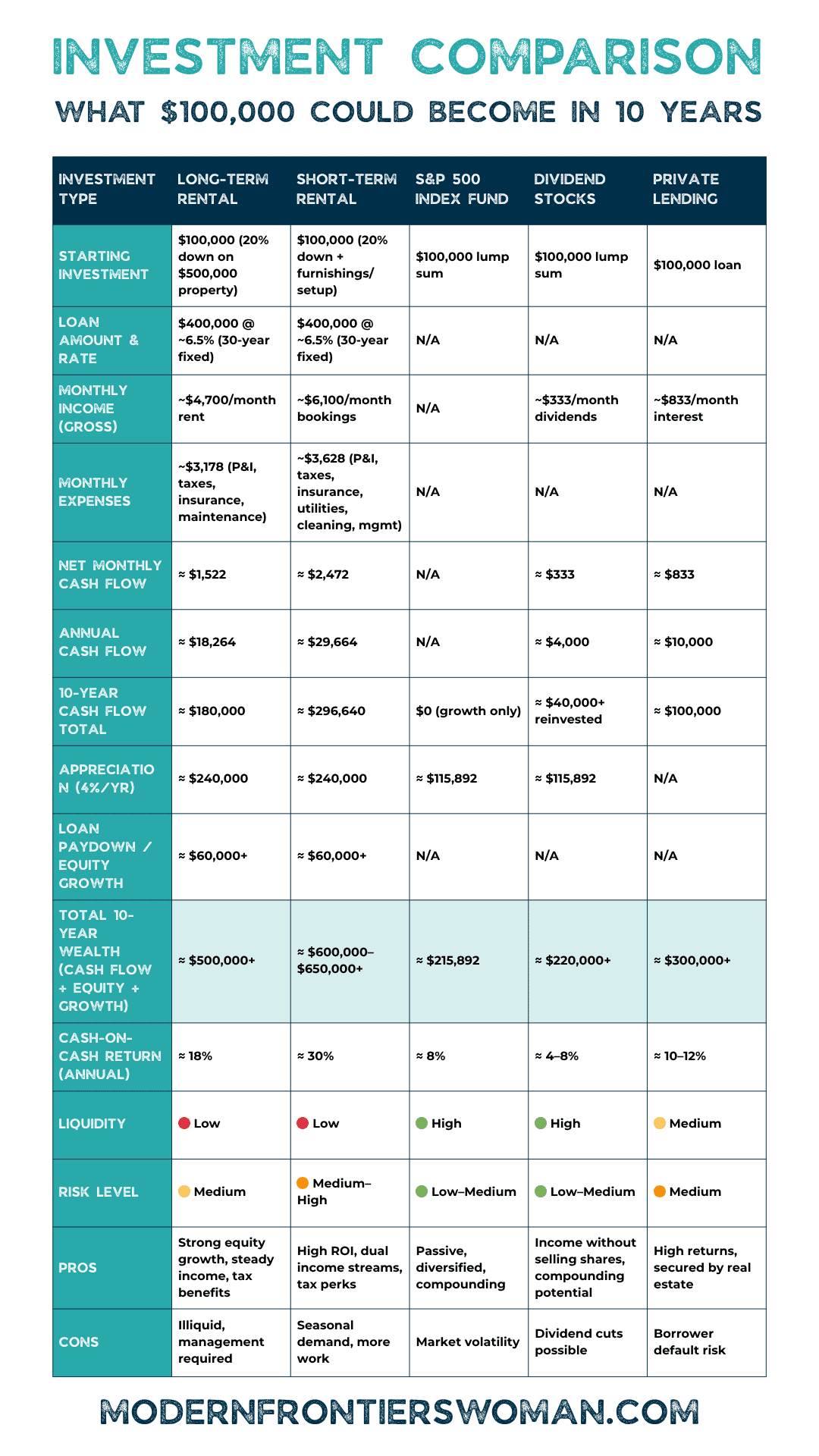
Investment Comparison: What $100,000 Could Become in 10 Years
| Investment Type | Long-Term Rental Real Estate | Short-Term Rental (Airbnb/STR) | S&P 500 Index Fund | Dividend Stocks | Private Lending |
|---|---|---|---|---|---|
| Starting Investment | $100,000 (20% down on $500,000 property) | $100,000 (20% down + furnishings/setup) | $100,000 lump sum | $100,000 lump sum | $100,000 loan |
| Loan Amount & Rate | $400,000 @ ~6.5% (30-year fixed) | $400,000 @ ~6.5% (30-year fixed) | N/A | N/A | N/A |
| Monthly Income (Gross) | ~$4,700/month rent | ~$6,100/month bookings | N/A | ~$333/month dividends | ~$833/month interest |
| Monthly Expenses | ~$3,178 (P&I, taxes, insurance, maintenance) | ~$3,628 (P&I, taxes, insurance, utilities, cleaning, mgmt) | N/A | N/A | N/A |
| Net Monthly Cash Flow | ? $1,522 | ? $2,472 | N/A | ? $333 | ? $833 |
| Annual Cash Flow | ? $18,264 | ? $29,664 | N/A | ? $4,000 | ? $10,000 |
| 10-Year Cash Flow Total | ? $180,000 | ? $296,640 | $0 (growth only) | ? $40,000+ reinvested | ? $100,000 |
| Appreciation (4%/yr) | ? $240,000 | ? $240,000 | ? $115,892 | ? $115,892 | N/A |
| Loan Paydown / Equity Growth | ? $60,000+ | ? $60,000+ | N/A | N/A | N/A |
| Total 10-Year Wealth (Cash Flow + Equity + Growth) | ? $500,000+ | ? $600,000–$650,000+ | ? $215,892 | ? $220,000+ | ? $300,000+ |
| Cash-on-Cash Return (Annual) | ? 18% | ? 30% | ? 8% | ? 4–8% | ? 10–12% |
| Liquidity | ? Low | ? Low | ? High | ? High | ? Medium |
| Risk Level | ? Medium | ? Medium–High | ? Low–Medium | ? Low–Medium | ? Medium |
| Pros | Strong equity growth, steady income, tax benefits | High ROI, dual income streams, tax perks | Passive, diversified, compounding | Income without selling shares, compounding potential | High returns, secured by real estate |
| Cons | Illiquid, management required | Seasonal demand, more work | Market volatility | Dividend cuts possible | Borrower default risk |
How to read this: The “Total 10-Year Wealth” line gives you the most complete picture of how each $100,000 investment could grow over a decade—factoring in cash flow, appreciation, equity, and reinvestment. Long-term rentals shine as a steady, tax-advantaged wealth builder, while short-term rentals offer the highest overall returns but require more active management. Stocks and dividend portfolios grow more slowly but are highly liquid and hands-off, while private lending sits in the middle—delivering strong returns without property ownership.
Invest in Yourself: The Most Overlooked Wealth Strategy
When you ask “What would you do with $100,000?”, don’t forget the most powerful answer: invest in yourself. The skills, businesses, and assets you build can yield exponential returns for decades.
Start or Scale a Business
Launching or expanding a business is one of the fastest ways to grow $100,000 into a six- or seven-figure asset.
That money could fund:
- A real estate business (like an Airbnb management company or investment portfolio)
- An e-commerce store or digital product line
- A content-driven brand that monetizes through ads, affiliates, and courses
- A local service business with recurring revenue
Example: A $100,000 investment into a small business that nets just $4,000/month is $48,000/year—a 48% annual return. And if that business grows, the ROI can snowball far beyond what stocks or real estate alone can achieve.

Level Up Your Knowledge and Skills
One of the smartest answers to “What would you do with $100,000?” is: make yourself more valuable. Education isn’t an expense—it’s an investment that pays for life. Whether you’re an entrepreneur, investor, or career professional, new skills compound your earning potential for decades.
- Real estate licenses, appraiser certifications, or property management training
- STR (short-term rental) business or Airbnb Mastery courses
- Degrees or specialized programs in finance, marketing, or data science
- Coaching, mentorship, or masterminds with industry leaders
Example: If a $10,000 certification increases your income by $20,000/year, that’s a 200% return in year one—and it continues compounding every year after.
Build Digital Assets
Use part of that $100,000 to build online income streams with minimal upkeep by investing in digital assets that can run semi-passively once established:
- Create a blog or niche website that earns ad and affiliate income
- Develop an online course or membership community
- Build a YouTube channel, newsletter, or podcast
- Invest in SEO, branding, and digital marketing to grow your reach
Digital assets appreciate in value and can even be sold like businesses. Websites often sell for 30–50x monthly income, meaning a site that earns $3,000/month could sell for $90,000–$150,000.
Improve Existing Properties
If you already own real estate, part of your $100,000 could be used to increase property value and income:
- Add a short-term rental unit or ADU (Accessory Dwelling Unit)
- Renovate outdated spaces to boost rent or resale value
- Add amenities (like a hot tub or outdoor kitchen) that increase nightly STR rates
A $30,000 renovation that raises property value by $75,000 is a 150% ROI—and you still collect increased cash flow in the meantime.

Other Creative Ways to Use $100,000
Still wondering “What would you do with $100,000?” The truth is, there’s no single “right” answer—because there are dozens of powerful ways to put that money to work depending on your goals, timeline, and appetite for risk. Beyond the major strategies we’ve already covered, here are more options worth considering that can help you diversify, protect, and grow your wealth in different ways:
Invest in Startups & Innovation
If you’re open to higher risk for potentially higher reward, platforms like WeFunder, StartEngine, and Republic allow you to invest in startups through crowdfunding or angel investing. A single successful company can multiply your initial investment many times over. Even a small portion of your $100,000 allocated here can significantly boost long-term returns.
Peer-to-Peer Lending Platforms
Peer-to-peer lending platforms like LendingClub or Prosper allow you to act as the bank, lending money directly to individuals or small businesses. With typical returns ranging from 6% to 12%, this can be a strong source of passive income. It’s also a good way to diversify outside traditional stocks and real estate.
Explore International Real Estate
Investing in real estate abroad can offer higher returns, lifestyle benefits, and currency diversification. From vacation rentals in Mexico, Honduras, or Portugal to farmland in South America, international properties often cost less upfront and provide strong appreciation and rental potential—all while expanding your wealth beyond U.S. markets.
Land Banking: Buy & Hold Dirt
Raw land is one of the simplest and most overlooked ways to grow wealth. Buying undervalued land in the path of development and holding it for future appreciation can deliver significant returns—often without the headaches of tenants or maintenance. You can also add value by subdividing or rezoning the land before resale.
Plan for Generational Wealth with Trusts & Estate Planning
$100,000 can also be used to set up a living trust, fund a family foundation, or work with an estate attorney to create a plan that protects and passes down your wealth efficiently. Strategic estate planning helps minimize taxes and ensures your money benefits future generations exactly as you intend.
Pay Off High-Interest Debt
Not all investments involve buying something new—sometimes the best return comes from eliminating costly debt. Paying off a credit card with a 20% interest rate is like earning a guaranteed 20% return on your money—something no stock or real estate investment can promise.
Buy or Build a Business
Consider using part of your $100,000 to purchase an existing cash-flowing business or franchise, or to launch your own venture. Even a small business generating $3,000/month in net profit produces $36,000 per year, a 36% annual return—and the business itself often appreciates in value over time.
Precious Metals & Inflation Hedges
Allocating a small portion of your portfolio to gold, silver, or other commodities can hedge against inflation and currency fluctuations. While they don’t generate income, they can help preserve wealth during economic downturns and add stability to a diversified portfolio.
Cryptocurrency, Foreign Currencies & NFTs
Cryptocurrency like Bitcoin and Ethereum can offer high-growth potential, while stablecoins provide 5–8% yields when staked or lent. Because crypto is volatile, many investors limit it to 5%–20% of their portfolio for balance.
Beyond crypto, investing in foreign currencies (known as forex trading) can diversify your wealth beyond the U.S. dollar. Holding strong global currencies like the euro, yen, or Swiss franc—or trading on exchange rate movements—can act as a hedge against inflation and currency risk.
You can also explore NFTs (non-fungible tokens)—digital assets tied to art, media, or virtual real estate. While speculative, they can offer unique opportunities for growth and income, especially in emerging digital economies.

Diversification & Advanced Strategies: How the Wealthy Multiply $100,000
If you ask ten experienced investors, “What would you do with $100,000?”, you’ll get ten different answers—and that’s the point. The most successful wealth builders don’t rely on a single investment. They diversify, spreading their money across different assets that work together to balance risk, maximize returns, and build resilience against market shifts.
Diversification isn’t about playing it safe—it’s about building a portfolio that keeps growing no matter what the economy is doing. Real estate might deliver cash flow and appreciation, stocks might provide liquidity and compounding, and private lending might bring in steady passive income. When one area slows down, another often surges ahead. Together, they create a portfolio that’s stronger than the sum of its parts.
Bottom Line: “What would you do with $100,000?” doesn’t have one answer—because the wealthiest investors don’t choose just one. They layer strategies, mix passive and active investments, and allocate funds across short-term income, long-term growth, and future protection. Whether you’re investing in retirement accounts, launching a business, buying real estate, or funding a trust, the key is to make every dollar part of a bigger plan for financial freedom.
A Sample Diversified $100,000 Strategy
Here’s what a balanced approach might look like:
- $50,000—Down payment on a rental property: Build equity, appreciation, and monthly cash flow.
- $20,000—S&P 500 index fund or mutual fund: Compound growth with high liquidity and zero maintenance.
- $10,000—Dividend stocks: Generate income that grows every year while reinvesting dividends.
- $10,000—Private lending or REITs: Earn strong interest-backed returns secured by real estate.
- $10,000—Invest in yourself: Launch a business, gain new skills, or build a digital income stream.
This mix gives you immediate income, long-term growth, appreciation, tax advantages, and liquidity—all at the same time. It also means you’re not relying on one market to make or break your future.
Advanced Wealth-Building Strategies
Once your foundation is strong, there are advanced strategies that can take your wealth-building to the next level:
- Portfolio Leverage: Use the equity in your rental property or the value of your stock portfolio as collateral for new investments. For example, borrowing 50–70% against a portfolio at 6% and reinvesting it into private lending at 10–12% can create “spread income” without selling your assets.
- BRRRR Method (Real Estate): Buy, Rehab, Rent, Refinance, Repeat—a powerful strategy to recycle the same $100,000 into multiple properties over time.
- 1031 Exchanges: When selling investment properties, reinvest the proceeds into new properties tax-deferred—allowing your capital to grow faster.
- Bonus Depreciation: Especially for short-term rentals, bonus depreciation lets you write off a large portion of the property value in the first year, often wiping out your taxable income.
- Business + Real Estate Hybrid: Combine strategies by using real estate as part of your business. For example, own the building your business operates in, so you’re paying yourself rent and building equity simultaneously.
These advanced tactics are how seasoned investors turn one $100,000 decision into a multi-million-dollar portfolio. They use leverage intelligently, compound tax advantages, and keep their money working in multiple places at once.
Bottom Line: Diversification isn’t just a safety net—it’s a growth strategy. When you spread $100,000 across multiple wealth-building avenues, you reduce risk, unlock more income streams, and create a portfolio that thrives in any market. That’s the difference between someone who invests once and someone who builds lasting generational wealth.

Final Thoughts: It’s Not About the $100,000—It’s About What You Do With It
At the end of the day, “What would you do with $100,000?” is really a question about your vision for the future. Will you spend it once, or make it work for you for decades? Will you build something that grows while you sleep, or let it sit idle in a savings account losing value to inflation?
Whether you invest in real estate, stocks, a business, or yourself, the smartest strategy is one that builds momentum and layers your wealth. Your $100,000 is more than a lump sum—it’s a seed. With the right choices, it can grow into something far larger, more powerful, and more life-changing than you ever imagined.
Ready to Put Your $100,000 to Work?
If real estate is part of your wealth plan, I can help you find, analyze, and close the right properties—whether you’re local to Michigan or investing from across the country. Enroll in my Business Coaching for Investors for one-on-one, custom-tailored strategy sessions with me. Join my Real Estate Investor Insider List »

Subscribe
More Tips From a Pro Investor . . .
Finance Tips
- What To Do When Inheriting A Large Sum Of Money
- Unique Money Moves: Beginner-Friendly Investment Strategies That Work
- How to Protect Your Money: 4 Habits for Long-Term Wealth
- NFTs in Three Easy Steps: A Quick Beginner’s Guide
- The Ultimate Guide to Financial Independence
- How To Make Financial Milestones More Attainable
- 5 Ways to Save Money and Achieve Financial Freedom
- Master Your Money: How Budgeting Can Transform Your Life
- 75+ Side Hustles for Farmers to Boost Income
- 5 Money Saving Tips to Protect Household Finances
- 15 “Attainable” Ways to Reduce Waste and Save Money Now!
- 22 Eco Friendly Products to Replace Disposables and Save you Thousands a Year!
- Shaving Dollars From Your Grocery Bills: Shopping Tips to Save Money
- 5 Money Saving Tips to Protect Household Finances
- Smart Spending: How To Cut Costs Without Sacrificing Quality
- Quick Startup Guide to Selling Products Online
- 3 Essential Tips to Run a Successful Business & Make a Profit
- Overwhelmed By Debt? Here’s How to Get Through It
- 7 Foolproof Strategies to Tackle Your Financial Stress
- Smart Money Moves Every Remote Worker Should Know
Real Estate Investing Tips
- From Curious to Confident: Your Real Estate Wealth Journey Starts Here
- Profitable Real Estate Investment Strategies: Tools, Tech, and Resources
- Secrets of Investing in True Luxury Real Estate
- 6 Real Estate Metrics All Pro Investors Track
- How to Start Real Estate Investing with Just $100
- Rethinking Your Career Path? How to Start Working in Real Estate
- 5 Best Places to Buy Affordable Rural Land in the U.S. Reviewed 2025
- Vacation Rental Interior Design Tips: Create a Space Guests Will Love (and Book Again)
- What to Look for When Buying a Student Rental
- Why Honduras Property Investment Is a Smart Choice for Your Real Estate Portfolio
- Landlord Diaries: Is Passive Income Ever Really Passive?
- Should You Invest in a Commercial Property or Rent?
- How to Handle a Landlord Dispute with Your Tenant
- Six Simple Steps To Stress-Free Real Estate Investing
- Top Commercial Real Estate Investment Strategies: Upgrades That Maximize ROI
- Top Neighborhood Features to Look for When House Hunting
- Buying a Home Overseas? Practical Tips for a Smart Purchase
- Eco-Friendly Home Renovations to Maximize your Sale Price
- The Biggest Mistakes Families Make when Inheriting Land
- How to Handle a Landlord Dispute with Your Tenant
Real Estate Investing Tools
- Evolve Vacations – Receive a $250 management fee credit when you sign up for professional property management with Evolve Vacations through my agent link! I love Evolve’s industry low 10% management fee and toolbox of smart technology for vacation rental owners. Email me for more information on how I manage my investment properties with Evolve.
- Realbricks – Looking to break into real estate investing without needing thousands of dollars upfront? I’ve partnered with Realbricks, a fractional investing platform that lets you own real shares of rental properties for as little as $100. Sign up using my referral code ASAE20 to receive 50 free shares to start your investing journey.
- Showplace – Showplace is a streamlined, full-service solution for property owners who want to boost their home’s appeal, value, or rental income with professional design, renovation, and furnishing packages.
- Deal Check – Deal Check is an amazing tool I use to analyze potential real estate investments. Before purchasing a new vacation rental property, I always run numbers through this app to verify the investment potential. Use my special discount code BESTDEAL for 20% off your subscription.
- VRBO – VRBO is the world’s leading online marketplace for the vacation rental industry representing over 2 million vacation rentals in 190 countries. VRBO is a part of the Expedia, Inc. family of brands.
- RentRedi – RentRedi has an all-in-one property management software for landlords. Collect rent online with their mobile app.
- Lofty – Lofty is a cutting edge customer relationship manager (CRM) for real estate agents. After using Lofty’s Sales Acceleration Platform, my lead volume, conversion rate, sales, and commissions have skyrocketed! The all-in-one solution includes CRM, IDX Website, AI Sales Assistant, Marketing Automation, and more. Check it out! – Register for a demo using my referral link.
Share this Post on Social Media!
For more inspiration follow my Pinterest Board: Finance and Investment.
For more inspiration follow my Pinterest Board: Real Estate for Agents, Owners, and Investors.